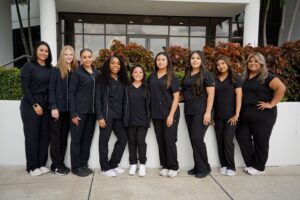
July 22, 2026 – South Florida State College (SFSC) honored nine graduates of its Dental Assisting program in a pinning ceremony in the SFSC University Center on the Highlands Campus in Avon Park on Thursday, July 16. Dental Assisting graduates receiving their pins were: Maria Hernandez, Chloe Dean, Lynaya Rumberger, Darlene Satine, Sandy Vue, Karen Morales-Ramos, Nereida Flores Becerra, Gisseel Perez, and Ana Arvea-Carrillo.
All of the graduates earned their Career Certificate in Dental Assisting and received their Expanded Functions Dental Assisting Certification and Florida Orthodontic Assistant Certification.
Maria Hernandez was presented with the Academic Excellence Award, Sandy Vue received the Radiography Excellence Award, Darlene Satine was honored with the Clinical Safety and Infection Control Award, and Karen Morales-Ramos earned the Professional Growth and Resilience Award during the ceremony.
After completing the 11-month Career Certificate program in Dental Assisting, graduates can be employed as state-certified dental assistants by having earned their Expanded Functions and Radiology certifications. They are also qualified to earn the national Certified Dental Assistant (CDA) designation by passing the Dental Assisting National Board Examination (DANB).
For information about SFSC’s Dental Education programs, call 863-784-7027 or email healthsciences@southflorida.edu.
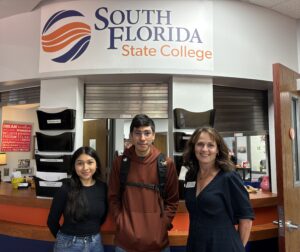 July 15, 2026 – The Roberts Community Foundation through the Community Foundation of Sarasota County has granted South Florida State College (SFSC) Foundation $26,000 for Panther Prep, a six-week program that helps high school students learn about their world, fulfill their potential, and discover that a college degree is within reach.
This is the second year that Panther Prep has received funding and this year, the Community Foundation of Sarasota County supported each student with $2,200, allowing 15 students to attend.
This summer bridge program prepares students for college by helping them improve their academic performance and life skills. They participate in mathematics immersion and develop teamwork, communication, time management, and financial literacy skills through 5G Power Skills Certification and Panther Power Hour. Additionally, students will be able to earn college credits in Master Student/College Success and Freshman English I. To further support success, they’ll be assisted in navigating college systems, career planning, and financial aid.
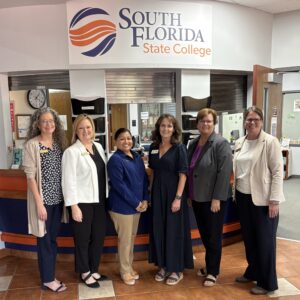
“This unique and special opportunity for our graduating high schoolers is made possible by The Community Foundation of Sarasota, because they care about seeing young adults in Florida’s Heartland reach their potential,” said Asena Mott, SFSC dean of off-campus instructional sites. “The small window of time between high school and a traditional fall start for college is often overlooked. In actuality, it’s a space where students can improve their foundational learning and study practices to set them up for success.”
Panther Prep meets Monday through Thursday, June 25 through Aug. 3, on the SFSC DeSoto Campus in Arcadia. Classes are held Monday through Wednesday, from 10 a.m. to 4 p.m., and on Thursdays, from 10 a.m. to 2 p.m. Lunch is provided daily.
The program is open to DeSoto County residents who graduated from high school this spring, whether they graduated from public or private schools, have been homeschooled, or have earned a diploma through a GED program.
Tuition and books are free and lunch is provided. Students received a Panther Prep kit that included a backpack, lanyard, USB drive, notebook, calculator, and a Panther Prep t-shirt. Students who complete Panther Prep receive $450 toward the purchase of a laptop from the SFSC Bookstore when they enroll in fall classes at SFSC.
For more about the Panther Prep program, contact the SFSC DeSoto Campus at 863-993-1757 and ask for Irene Cerna, or call DeSoto High School at 863-494-3434 and ask for counselor Gerri Lewis or the graduation coach.
About the Community Foundation of Sarasota County
The Community Foundation of Sarasota County is a public charity founded in 1979 by the Southwest Florida Estate Planning Council as a resource for caring individuals and the causes they support, enabling them to make a charitable impact on the community. With assets of $605 million in more than 1,600 charitable funds, the Community Foundation awarded grants and scholarships totaling $44.7 million last year in the areas of education, the arts, health and human services, civic engagement, animal welfare, and the environment. Since its founding, the Community Foundation has been able to grant more than $542 million to area nonprofit organizations in our community thanks to the generosity of charitable individuals, families, and businesses. For more information, visit cfsarasota.org or call 941-955-3000.
July 1, 2026 – South Florida State College (SFSC) and Moses Media were honored with a Gold Award in the 41st Annual Educational Advertising Awards for the “It’s Possible” video.
The Educational Advertising Awards is a national competition to recognize the field of educational marketing and advertising. A national panel of industry specialists review each piece for creativity, marketing execution, and message impact. This year, 54 categories were judged for Best in Show, Gold, Silver, Bronze, and Merit designations for exceptional quality, creativity, and message effectiveness.
“It’s Possible” was created to highlight the programs and activities on SFSC’s campuses and Moses Media, from Nashville, Tenn., was hired to capture and tell SFSC’s story. The video won gold in the Digital Video Ad – Less than 2 minutes category. “It’s Possible” can be viewed on the College’s YouTube channel at youtube.com/@SouthFloridaStateCollege.
“As showcased in our “It’s Possible” video, we highlight real students, real experiences, and the many educational and athletic options available at South Florida State College,” said Melissa Kuehnle, Ed.D., director of institutional communications at SFSC. “This video is an example of how we bring our mission to life in a way that is both authentic and inspiring. It has become a cornerstone of our promotional efforts by connecting emotionally and socially with our community and showing them what’s possible at SFSC, while including familiar and friendly faces.”
For more information about SFSC, visit southflorida.edu or call 863-453-6661. SFSC is also on social media as @SFSCPanthers on Facebook, Instagram, LinkedIn, Threads, and X.
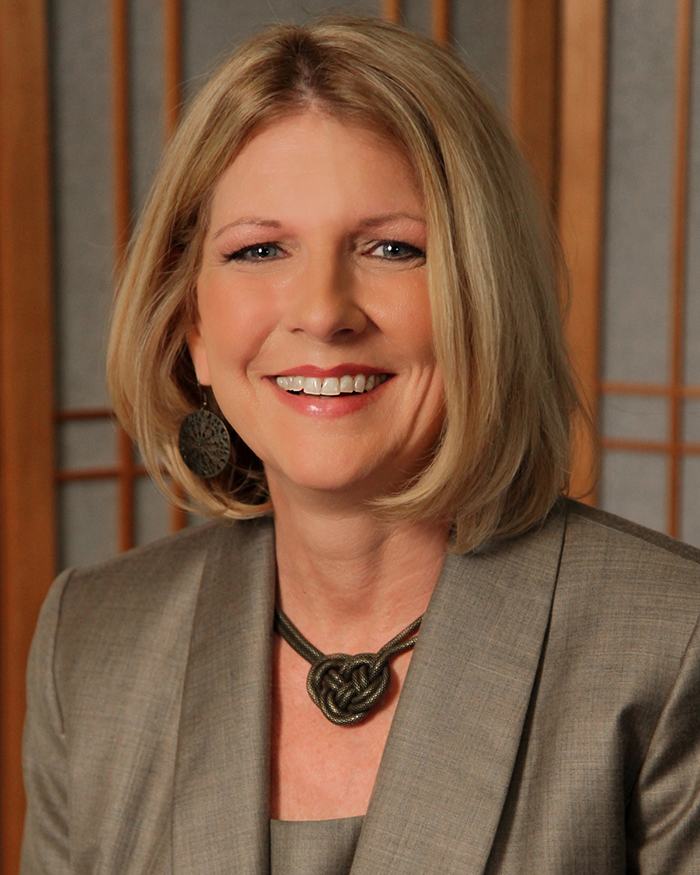 AVON PARK, Fla. – July 1, 2026 – South Florida State College (SFSC) alumna, Barbara Stites, who graduated with an Associate in Arts from the College in 1974, spent most of her career in Library and Information Sciences. Although now retired, she looks back on her personal and professional life with a great sense of accomplishment and service to libraries throughout Florida.
Stites earned her doctorate in Leadership and Education with a specialization in Human Resource Development from Barry University, a Master of Arts in Library and Information Science from the University of South Florida, and her Bachelor of Arts in Education from the University of South Florida.
However, Stites’ academic and professional careers may never have come to pass, but for Stites’ own tenacity as well as the generosity of one person who strongly believed that education paves the road to a better life.
Stites’ family moved to Broward County, Fla. from New Jersey when she was 10 years old. At age 15, she moved to Lake Placid and, later, graduated from Lake Placid High School.
“My father graduated from Pace University in New York on the GI Bill after World War II,” she said. “But my parents were divorced and I didn’t have much contact with my dad. So, college wasn’t familiar to me. I came from serious poverty. We lived in a travel trailer in a trailer park in Lake Placid. I moved out of my mother’s place when I was 16 and was then on my own. I just wanted to do what I wanted to do when I wanted to do it. I was a feisty teenager.”
Stites decided that she wanted to become a librarian. “I was a curious individual and just loved learning,” she said. “I like reading — it was an escape for me. But I just loved digging through information. I love the hunt, just as people go to thrift stores and hunt for good deals. Some people like to go fossil hunting. I loved the idea of researching.”
But Stites felt somewhat limited in her resources to become a librarian. “At the time in Central Florida, a woman had three choices: she could become a secretary, a nurse, or a teacher,” she said.
Stites knew little about pursuing a college degree or how to apply for college. In fact, she was unaware that South Florida State College (South Florida Junior College at that time) existed in her own community. “But I heard that a scholarship was available through the Lake Placid Rotary Club,” she said. “And I considered going to secretarial school. The man who was in charge of the Rotary’s scholarships was Mr. Wilkins.”
When Stites applied for the Rotary scholarship, Mr. Wilkins contacted her and said that the scholarship was for college, but that secretarial school wasn’t considered college. He said, “I have an idea. How about I pay for your first semester of secretarial school personally?” Stites agreed.
A few months later, Stites spoke with Mr. Wilkins and said that she learned about South Florida State College in Avon Park and would like attend. Mr. Wilkins agreed to pay for her first semester at the College.
“By the end of my first semester at the College, I got straight A’s,” Stites said. “Then Mr. Wilkins said he’d pay for my second semester. After that, I had gotten married and was able to take care of my own financial obligations. All these years later, I’m a strong supporter of scholarships. They change lives. Mr. Wilkins changed my life.”
Stites blossomed as a student at SFSC. “Between the staff, faculty, and other students, everybody was encouraging. It had a positive, ‘Can Do’ atmosphere. They recognized that students are out there like me who need an extra hand.”
Stites took an astronomy class at SFSC from Dr. Bill Gene Smith. “In his class, we learned more about education than we did astronomy, because he was running for the Highlands County School Board for the first time,” she said. “And he wanted to talk about education. It inspired me.”
After graduating from SFSC, Stites continued her education at the University of South Florida in Tampa. “Three women I knew from SFSC and I carpooled from Highlands County to USF to take classes,” Stites said. “We’d get up at 4 a.m., attend classes all day, then drive home.”
Right out of college, Stites was offered a job at Lake Placid Elementary School, teaching first, second, and third grades. She taught at the school for over nine years.
“All the while, I still had the desire to be a librarian,” she said. “But to be an entry-level librarian, you needed a master’s degree. So, I went back to college, driving to Tampa, Fort Myers, and Orlando for classes.” Stites earned her master’s degree and took her first job as a librarian at Sebring High School, working with Peggy Smith, Dr. Bill Gene Smith’s wife.
As the years passed, Stites worked as a librarian in a corporation and at a law firm. “I was training lawyers and accountants in how to do research. But they were being paid far more money than I. So, I made a list of the jobs that made the kind of money that I wanted to make.
A job came open as an executive director of a non-profit organization that paid good money. “It was a non-profit that was like a small business development center but for libraries,” Stites said. “So, I switched to leadership. That tipped me from frontline service as a high school or corporate librarian to leading an organization. That was a big shift for me.”
One of the highlights of Stites’ career came when she and colleague, Dr. Elizabeth Curry, created the first statewide training ground for library leaders in Florida called the Sunshine State Library Leadership Institute (SSLLI) that continues to serve a new generation of library leaders 20 years later.
“Around the late ‘80s or early ‘90s, a colleague of mine at the Tampa Bay Library Consortium and I talked about being able to provide internet access to the public. At the time, there was no internet access in people’s homes. We wrote a grant and got funding to provide the first internet access to the public in Florida. We rolled out the internet to a couple of rural libraries, some medium-sized libraries, and some larger libraries. We taught people about the internet, how it worked, what buttons to push. We did all the training that it took to get the first line of librarians trained so they could begin training the public on the internet and how to use it.”
“Eventually, we provided desktop access to the internet at all these test libraries, such as the one we set up in Wauchula. We also hooked up 11 large libraries so that they had the first online ‘card’ catalog.”
After four decades of library service, Stites retired in 2019 from her role as interim dean of the Florida Gulf Coast University Library. “When the university was new, I helped to build a library from the ground up. The library is the heart of a university. People come there to study and do homework, research, sleep, find a boyfriend, participate in student-centered activities. We did some serious research about student engagement in library spaces and what influenced that. We determined what kind of furniture supported that, what kind of lighting. We had a 133,000 sq. ft. building with 100 employees. We needed to manage a cadre of people like that and make sure they always provide the best customer service possible.”
Stites believes that in these times, the role of a librarian has changed, that you don’t just check out books. “Larger academic libraries are not so much about the books anymore. It’s about artificial intelligence and working with large data sets and crunching information. Public libraries have moved toward supporting people’s education and entertainment needs, but also their social needs. That requires the computer community supporting people who don’t have internet access.”
In Stites’ view, Information Sciences has become more and more important for the public. “So much of the information that we’re exposed to is not accurate,” she said. “Thinking about running a world on information that isn’t accurate scares me to death. It’s important that libraries and information scientists connect in any way they can with our students. Our main goal is to connect with students, employees, community members, and help connect them with information that they need to make the best decisions. If you’re at an educational institution, you’re supporting student learning and you’re supporting faculty research.”
To an extent, Stites’ early experience with college has come full circle. Her daughter, Emily Dabolt, is the executive director of institutional advancement at SFSC and oversees the SFSC Foundation. The Foundation solicits, receives, and manages charitable donations in support of the College, its programs, staff, and students. “My life changed through the scholarship from Mr. Wilkins and it led all the way to SFSC,” Stites said. “Emily has an opportunity to make a difference in other people’s lives through her job — along with all the support that’s at the College and from donors. A little generosity makes a huge difference in someone’s life.”