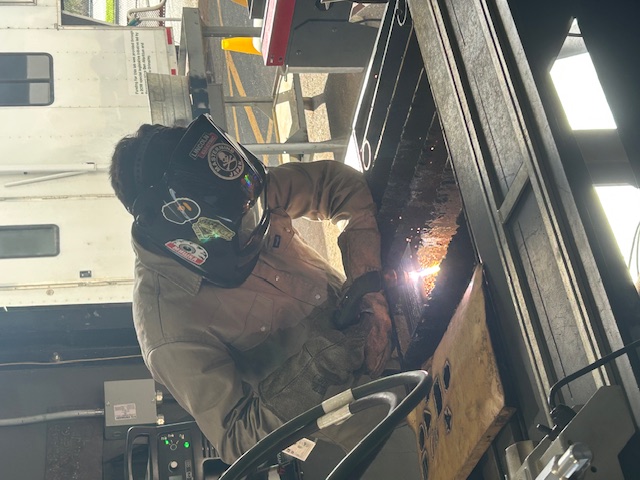
 Feb. 27, 2026 – The South Florida State College (SFSC) Foundation is proud to announce the establishment of the Randy Bateman Memorial Scholarship, a new endowed scholarship honoring the life and legacy of Randy Bateman, a lifelong Floridian and proud DeSoto County native who dedicated nearly 40 years to Florida Power & Light (FPL). The scholarship will support motivated, career-minded students pursuing work in the welding and skilled trade industry.
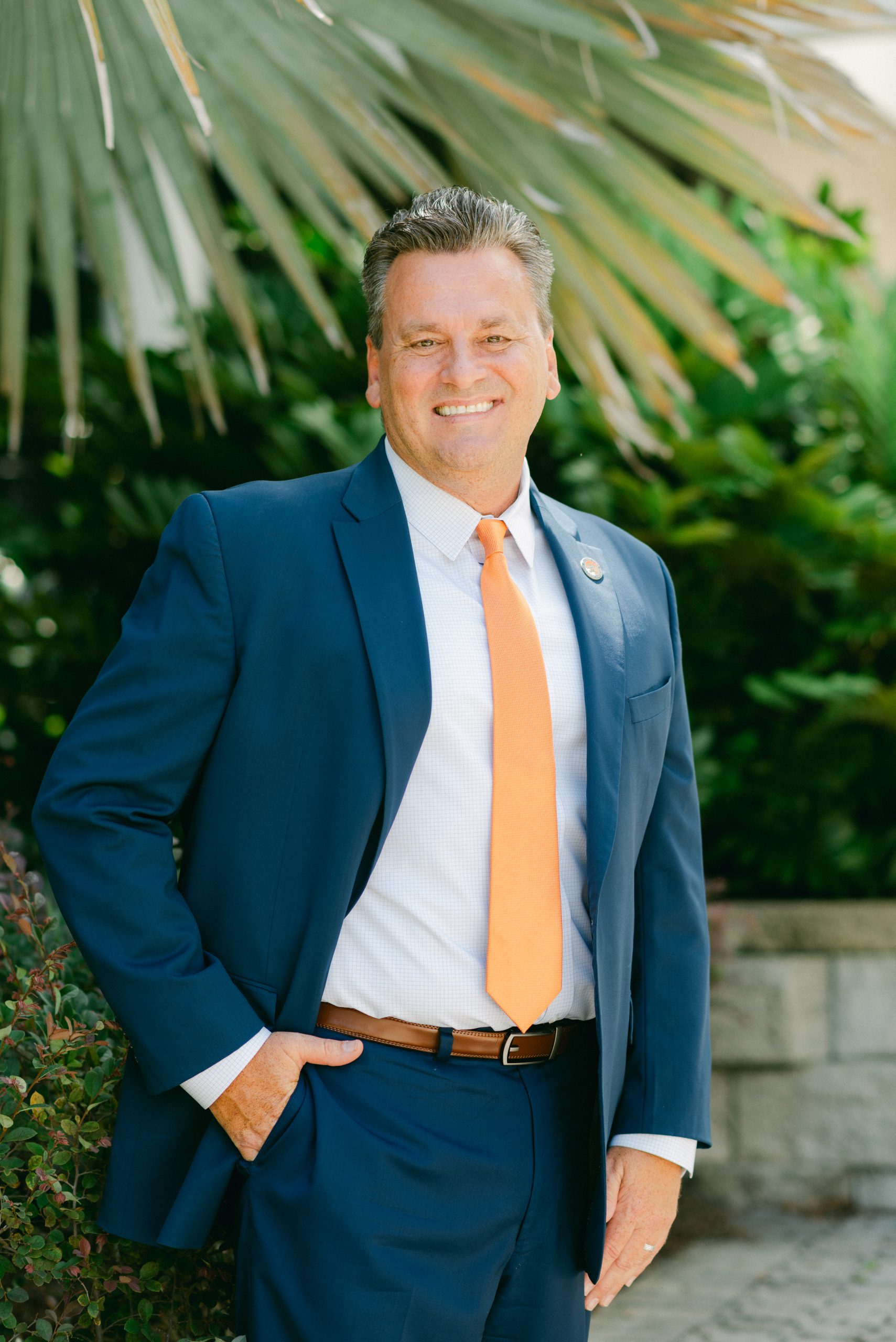 Feb. 10, 2026 – President Fred Hawkins has been named a Phi Theta Kappa (PTK) Paragon President Honoree. President Hawkins will be recognized during PTK Catalyst, Phi Theta Kappa’s annual international convention.
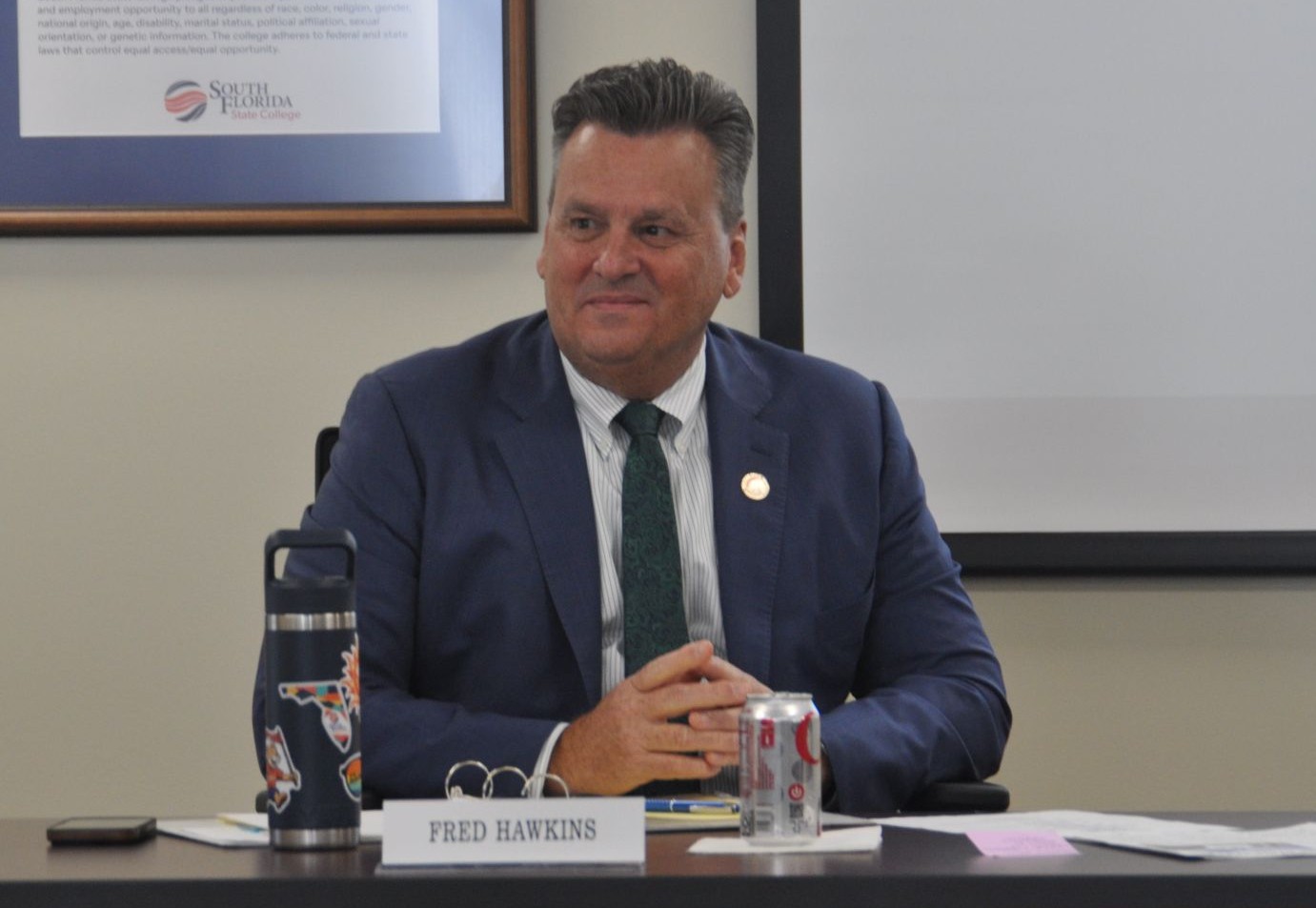 Feb. 12, 2026 – The South Florida State College (SFSC) District Board of Trustees (DBOT) conducted their annual review of President Fred Hawkins and laid out goals for 2026 at their regularly scheduled monthly meeting on Wednesday, Jan. 28, 2026.
The positive review of President Hawkins described him as communicative, effective, visible, dedicated, and highly engaged with students.
The DBOT goals for 2026 include:
- Continue to maximize revenues and minimize expenses
- Enhance economic development
- Advance student success and retention through graduation
- Increase community engagement and partnerships throughout the tri-county area
- Implement strategies to update current infrastructure
“The 2026 goals adopted by the District Board of Trustees continue to reflect our commitment to the continued success of our students and faculty while ensuring fiscal accountability and dedication to economic prosperity,” said John Eason, vice chair of SFSC’s DBOT. “By investing in modern infrastructure, and strengthening community partnerships, we are committing to keeping South Florida State College as a catalyst for workforce and economic development across the tri-county area.”
The DBOT meets monthly on the Highlands Campus of SFSC in Avon Park, Fla. For more information and meeting details, visit southflorida.edu/board-of-trustees.
 AVON PARK, Fla. – Feb. 11, 2026 – The Alan Jay Wildstein Center for the Performing Arts at South Florida State College (SFSC) announces four major national tours coming to the 1,460-seat venue in February.
“Following the enthusiastic response to Neil Berg’s hit Broadway revue ‘100 Years of Broadway,’ I am happy to announce that an all-new show, Neil Berg’s ‘100 Years of Hollywood’ is scheduled for Saturday, Feb. 21 at 7 p.m.,” said Cindy Garren, director of cultural programs at SFSC. “The musical revue includes some of the greatest songs from Hollywood’s greatest movie musicals and classic films with a superb New York band and five dazzling Broadway performers.”
Neil Berg’s “100 Years of Hollywood” recreates the greatest moments from movie musicals and classic films of the century, featuring the actual stars of hit Broadway shows such as “The Phantom of the Opera,” “Les Miserables,” “Evita,” “Fiddler on the Roof,” “CATS,” “Jesus Christ Superstar,” and “Wonderful Town.” These performers light up the stage with songs from classic and hit films such as “Breakfast at Tiffany’s,” “Casablanca,” “Wizard of Oz,” “Goldfinger,” “Moulin Rouge,” “A Star is Born,” “Dreamgirls,” “New York New York,” and many more. Neil Berg presents brilliantly revived arrangements of classics as well as fantastic numbers from Hollywood’s newest hit films.
The performance is sponsored by Dr. Catherine P. Cornelius, Jane Hancock and Don Appelquist, AdventHealth, and Thakkar, Patel and Avalos, MDs. Tickets are $36, $32, and $28 plus a $3 per ticket processing fee.

Rhythm of the Dance
Direct from Ireland, “Rhythm of the Dance” performs on Tuesday, Feb. 24 at 1:30 p.m. Featuring the National Dance Company of Ireland, the production is a two-hour celebration of Ireland’s rich heritage. This internationally acclaimed live production captivates audiences around the world with its champion dancers, top-tier traditional musicians, and stellar vocalists. Tickets for this high-energy show are $40, $35, and $30.
“Proud Tina,” produced by Showtime Australia, celebrates four decades of the Queen of Rock and Roll with a full live band, dynamic dancers, and soulful vocalists. Powerhouse vocalist Carole Borole delivers a night of hits that made Tina Turner one of the 20th century’s biggest names in music “Simply the Best,” “What’s Love Got to Do With It,” “Proud Mary,” “Nutbush City Limits,” “We Don’t Need Another Hero,” “Better Be Good to Me,” “I Can’t Stand the Rain,” “Private Dancer,” and many more. This show is not affiliated with Tina Turner.

Proud Tina
This performance is sponsored by Sedlock and Heston Construction, Dawn Dell, Broker Associate with Paradise Real Estate, Lampe and Kiefer Hearing Aid Center, MidFlorida Credit Union, Heartland Endodontics, and Bill and Lisa Jarrett.
The 30th anniversary tour of the Broadway hit, “Stomp,” makes a stop in Avon Park on Sunday, March 1 at 7 p.m. The international percussion sensation has garnered an armful of awards and rave reviews and has appeared on numerous national television shows. The eight-member troupe uses everything but conventional percussion instruments — matchboxes, wooden poles, brooms, garbage cans, hubcaps — to fill the stage with magnificent rhythm. Tickets for “Stomp” are $70, $60, and $45 plus a $3 per ticket processing fee.
Performances at the Wildstein Center for the Performing Arts are sponsored in part by the Florida Department of State, Division of Arts and Culture, and the National Endowment for the Arts. Tickets can be purchased in person at the SFSC Box Office located at 600 West College Drive, online at sfscARTS.org, or by phone at 863-784-7178. Significant discounts are available for groups of 12 or more.
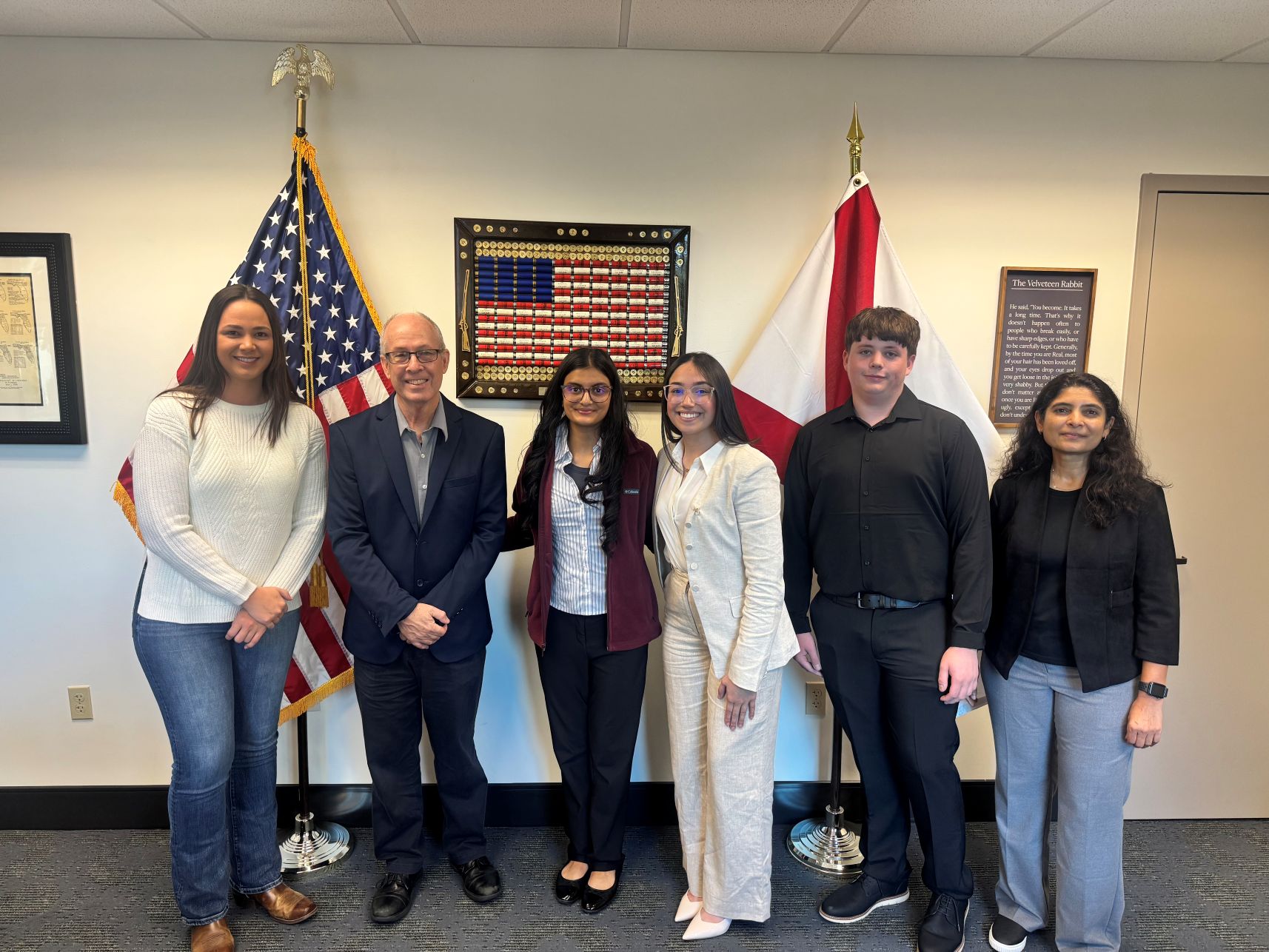 Feb. 4, 2026 – Undergraduate students from across Florida gathered at the state’s capital on Jan. 26–27, 2026, for the Florida Undergraduate Research Posters at the Capitol, a biennial event that celebrates student innovation and highlights the impact of undergraduate research on Florida’s future.
Hosted by the Florida Undergraduate Research Association (FURA) in partnership with Florida State University and Tallahassee State College, the event provided a unique opportunity for students to present their original research to state legislators, public officials, and university leaders inside the Florida State Capitol rotunda.
Each FURA institutional member nominated up to three students to represent their campus. The following students were selected to represent South Florida State College:
-
Jenale Alfonso: The Oral Microbiome as a Cardiovascular Biomarker: Bridging Dentistry and Cardiology (Mentors: Dr. Mintoo Patel and Sheryl McGrath)
-
Anika Bhandare: Molecular Markers for Early Detection of Colorectal Cancer Metastasis (Mentor: Dr. Mintoo Patel)
-
Cohen Jefferies: Conserving Florida’s Living Heritage (Mentors: Dr. Mintoo Patel and Dr. Kate Calvin)
Projects span diverse topics from human health to conservation and demonstrate how undergraduate research fosters problem-solving, creativity, and civic engagement.
FURA continues to strengthen the statewide undergraduate research network through its signature programs, including the Florida Undergraduate Research Conference (FURC), the Florida Statewide Symposium, and the Florida Undergraduate Research Journal (FURJ). The Posters at the Capitol event exemplifies the association’s mission to elevate undergraduate research and promote meaningful connections between students, institutions, and policymakers.
For more information about the 2026 Florida Undergraduate Research Posters at the Capitol, visit floridaundergradresearch.org.
About the Florida Undergraduate Research Association (FURA)
The Florida Undergraduate Research Association is a consortium of higher education institutions committed to promoting and enhancing undergraduate research across the state. FURA supports collaboration, mentorship, and outreach through statewide events, publications, and partnerships.
 As conversations about economic growth, workforce readiness, and community well-being continue, South Florida State College (SFSC) is consistently tied to organizations and corporations throughout the region.
According to a recent economic impact study examining fiscal year 2023–24, SFSC contributed $210.3 million in added income to the regional economy, which is equal to 4% of the area’s total gross regional product. To put that into perspective, one out of every 24 jobs in the region is supported by the activities of SFSC, its students, or its alumni.
This impact is not just anecdotal; it is evident in paychecks, positions, and career pathways across the region.
The Power of Alumni
The greatest economic contribution of SFSC comes from its alumni. Former students employed in the region generated $169.9 million in added income in a single year, supporting 2,216 jobs. SFSC’s alumni are nurses, technicians, first responders, educators, and skilled professionals, who residents interact with every day and whose education translates directly into production benefits and higher earnings for local industries.
Beyond alumni impact, SFSC’s day-to-day operations play a significant role in sustaining the local economy. The College employs 513 faculty and staff, with 82% living within the service area, ensuring that salaries are reinvested locally, supporting local businesses and community initiatives. The combined payroll and operational spending added $35.2 million to the regional economy.
Current students also contribute in a meaningful and valuable way, with 14% of SFSC students relocating to the area to attend the College, bringing new dollars into local communities through housing, food, transportation, and everyday expenses. Student spending added $5.2 million to the regional economy and supported 84 additional jobs.
Lucrative Futures
For students, the value proposition of SFSC is clear and measurable. Graduates who earned an associate degree in fiscal year 2023–24 will earn $6,200 more per year on average than peers with only a high school diploma. Over a working lifetime, that difference amounts to $260,400 in additional earnings per graduate.
When viewed as an investment, the return is staggering. For every $1 students invest in tuition, books, and income they temporarily set aside while investing in their education, they receive $7.50 in higher future earnings. The average annual rate of return for students is 22.9%, which is more than double the average for traditional long-term investment benchmarks. Students who invest in themselves strengthen not only their own futures, but the future of the communities they call home.
 Benefits to Taxpayers
The benefits of SFSC extend well beyond individual students. From a taxpayer perspective, the College generates more value than it costs. Over the working lives of its students, SFSC produces $42 million in combined tax revenue and public-sector savings, exceeding the $38.2 million in state funding it received.
At the societal level, the return is even more pronounced. The study estimates $607.6 million in total social benefits statewide, driven by higher lifetime earnings, increased business output, and reduced public costs related to healthcare, the criminal justice system, and income assistance. For every $1 spent by the College and its students, society gains $9.40 in benefits. In addition, when the public invests $1 in the College, they receive $1.10 back, so SFSC generates more value than it consumes.
More Than a College
These statistics tell an impressive story, but they only begin to explain SFSC’s role within the Heartland of Florida. The College is not simply an educational institution; it is an economic stabilizer, a talent pipeline, and a force multiplier for community prosperity. The strength of SFSC is currently felt by the 2,927 jobs across the region that are supported by the College.
At a time when Florida, like much of the nation, faces workforce shortages, demographic shifts, and economic uncertainty, South Florida State College stands as an inspiring solution. The region suffers from low attainment rates, with Highlands County ranked at 38 of the 67 counties, Hardee at 64, and DeSoto at 65, so the work continues. SFSC’s impact is measurable, its return on investment is undeniable, and its influence reaches far beyond the classroom.
SFSC’s mission is to develop human potential and create brighter futures, but its true impact cannot be confined to a single student or a single campus. The College is strengthening the region and revealing that education works best when it connects people, ideas, and opportunity. Within DeSoto, Hardee, and Highlands counties, the data reveals the influence of education on the economy, and the potential exists to further improve the imprint the College has on Florida’s Heartland.